•
Dallas Morning News
Review: Fort Worth shows deal sensitively with loss and its fallout
By Manuel Mendoza
FORT WORTH — Personal loss is at the core of two plays, a world premiere and a Pulitzer Prize winner, that opened last weekend to kick off one of the busiest North Texas theater months in recent memory. Each deals with death in different ways and to different ends while acknowledging an inevitable if painful reality of the human experience.
The premiere, Jason Odell Williams’ Destroying David, a one-person show in production at Circle Theatre, is based on historical and scientific fact; Primary Trust, Eboni Booth’s 2024 Pulitzer awardee for drama at Stage West Theatre, relies just on the playwright’s imagination. Both unfurl their narratives slowly and deliberately on minimalist sets around thought-provoking ideas. The performances are superb.
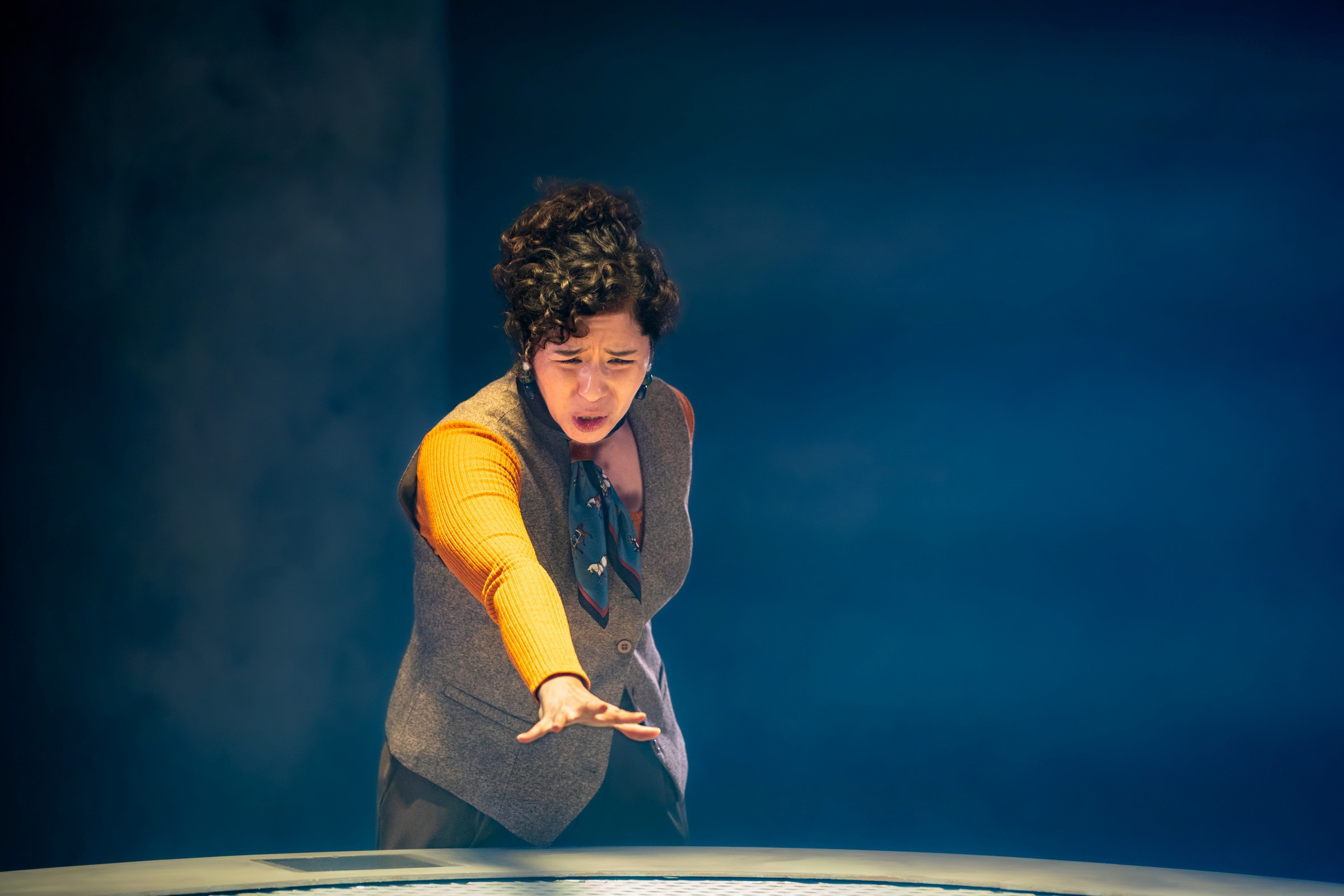
In David, an art restorer (the charismatic Amanda Nicole Reyes) gives the audience an after-hours tour of the Florence museum where the world’s most famous statue has been on display for 150 years after being moved from a public square. She relates the dire circumstances surrounding Michelangelo’s towering figure: His David is under threat of collapsing — has been from the start — due to the marble’s structural flaws and the artist’s design.
That she’s up to no good and why are withheld for a long time. The character, called “You,” has faced a grim event in her life that parallels the statue’s vulnerability and has changed her attitude toward impermanence.
Painted a blend of white and gray, the stark set in Circle’s basement performance space suggests a floor, walls and columns made of marble. At the center is a round platform with shelves holding such artifacts as bowls and busts. Above is a curtained opening in the ceiling. The platform and opening are where we’re to imagine the imposing David standing at its undetectably odd, dangerous angle. It’s also the site of the play’s denouement of pure stage magic. Evan Michael Woods directs with a light, sensitive touch.
Reyes’ restorer has a big personality with a sunny, confident delivery. She enters speaking Italian, enlisting audience members in partially improvised scenes. She cracks jokes about the inferiority of the Mona Lisa and recounts her stunned reaction the first time she saw the David at age 19.
An art restorer (Amanda Nicole Reyes) examines a model of the flawed foot of Michelangelo's famous statue in Jason Odell Williams' "Destroying David," premiering at Circle Theatre.(TayStan Photography)
She then delineates the history and science behind the peril the statue’s in, and it’s all true: The cracks in the original marble chosen 11 years before Michelangelo’s birth; its exposure to the elements for three decades; the eventual creation of the David in the early 15th century in ways that put additional stress on the ankles, especially the right one; its outdoor display for hundreds of years; and the earthquakes and man-made disasters that have always threatened it.
The flaws were first detected in the 19th century, but it wasn’t until geoscientists did a close study in 2014 that it became known how bad they were. Reyes’ character says she is one of the restorers working to save it. But she wonders whether like life, and by implication live experiences like this play, the David is meant to be ephemeral, best preserved in our memories.
When she eventually gets to her own tragedy — and its parallels to the statue’s situation — Destroying David returns to the kind of imaginative scenario that theater usually provides, with Reyes revealing a greater range of emotions. In her contemplation, she tells one more true tale: the 1497 Bonfire of the Vanities in which a Dominican friar organized a burning of all nonreligious art in Florence’s city square. (The David was commissioned in response four years later.)
When the space where the statue is supposed to be standing is suddenly animated by a ghostly but visible presence, you could hear audience members sniffling back tears. Without straining, Destroying David has shifted from fascinating history to a statement about how everything we love eventually disappears.